
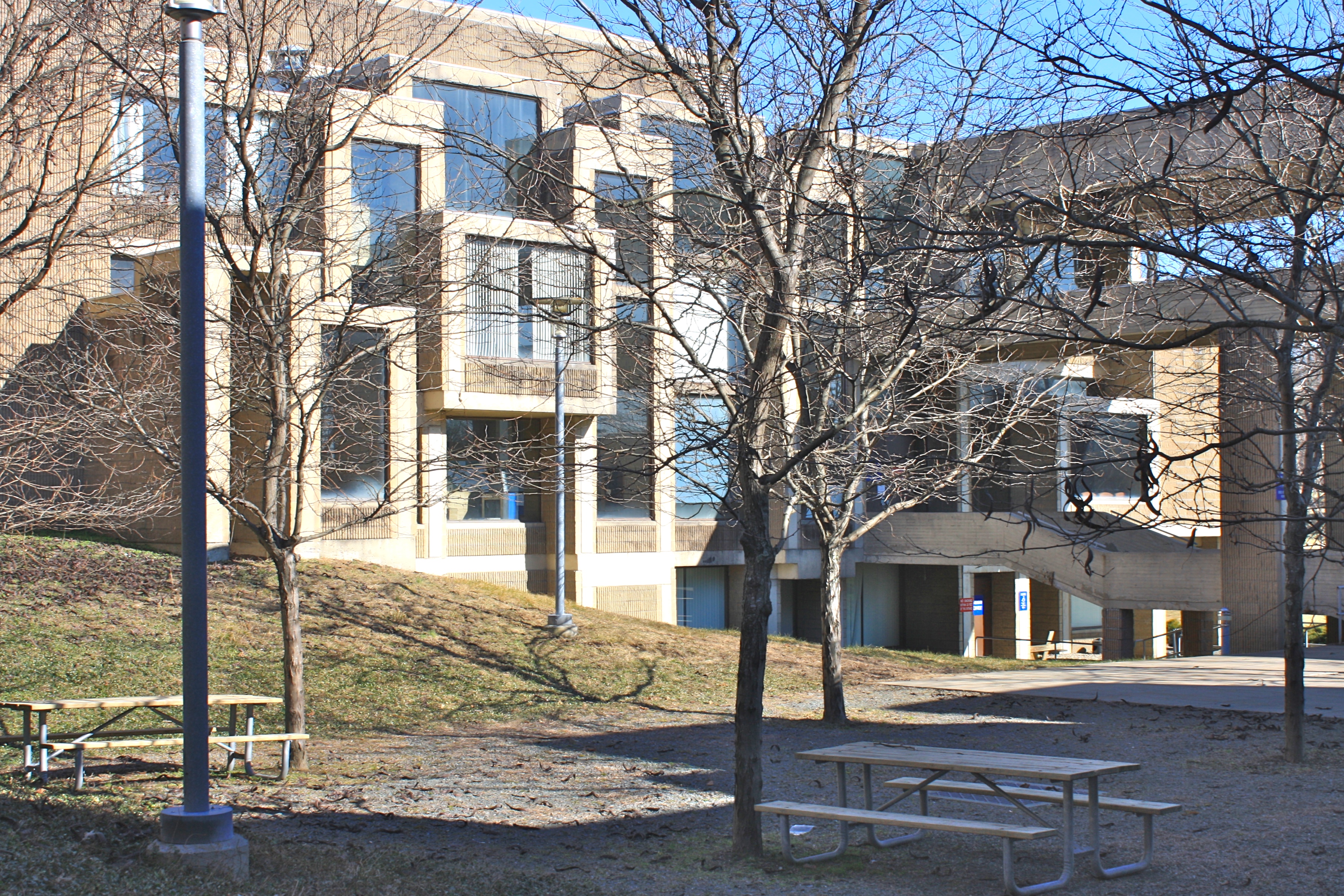
Looking straight at architect Paul Rudolph’s Orange County Government Center, in Goshen, N. Y., you may fear that its herd of concrete boxes atop concrete-brick piers are ready to stampede. It’s no longer obvious, but Rudolph designed his strangely aggressive exterior in service to a humanist idea. Buildings aren’t simply containers, those jostling boxes argue, they house civic life: executive functions, legislating, adjudicating. In his idiosyncratic way, Rudolph built a living monument to government that serves and involves citizens.
Gently Moving from Rural to Urban
The Government Center looks raw rising from a sea of surface parking. It would read as delicately scaled to the surrounding village had it not been set so far from nearby buildings on its largely flat and treeless 24-acre site. It would have made more sense framed by the scrim of trees Rudolph intended. If entered and used as designed, Rudolph’s building reveals an intricacy well suited to a county that teeters uneasily between rural and exurban. Citizens would have moved through a lush setting into the hidden, heavily planted garden that was built (as a transition from the rural to the “urban” Government Center). Separate lobbies open from the garden, one for the courts, the other serving the legislative and administrative areas.
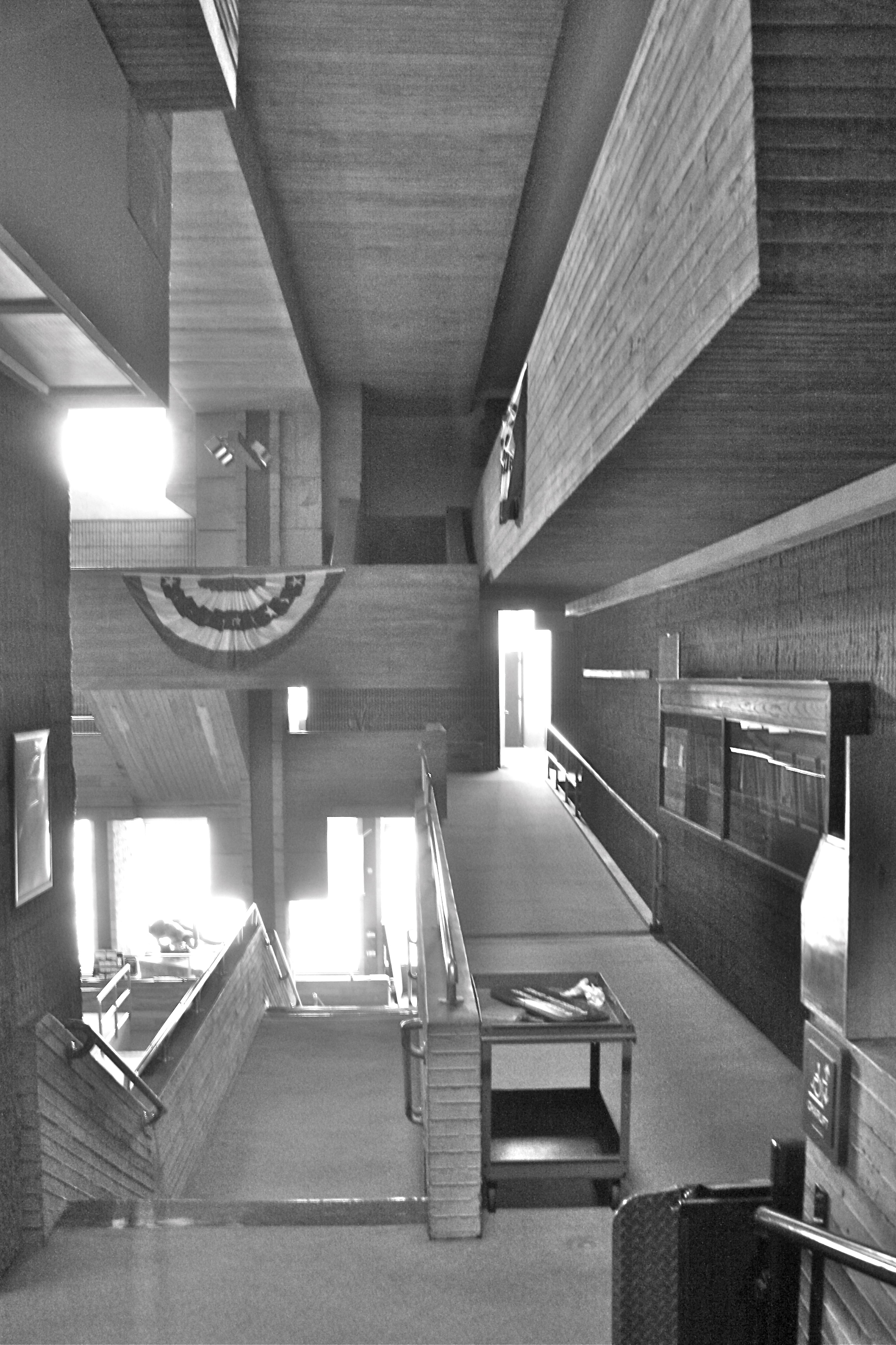
Inside, people used to ascend gentle terraces while tall monumental windows bathed them in daylight, arriving at a kind of town square for paying traffic tickets and tax bills surmounted by overhanging balconies, bridges and stairways that choreographed the movement of staff and visitors in three dimensions. Higher still, concealed light monitors still deliver shafts of daylight with the wondrous mystery of a Gothic chapel. The courtrooms are accessed in only a slightly less elaborate way. These are among the reasons the building got onto the World Monuments Fund’s watch list.

In its current neglected state, due to years of deferred maintenance, the case for restoring the 1971 Government Center is daunting. It’s got some 80 leaking roofs and dozens of giant windows sitting in rusting frames. A 2011 flood became then-county executive Edward A. Diana’s excuse to close the building he reviled (hoping to replace it with a larger structure in strip-mall Georgian).
Now the county legislature is looking at one proposal to tear down part of the center, restore the rest, and add a lumpen addition, proposed by the Rochester firm Clark Patterson Lee. Some are also tantalized by an offer by Gene Kaufman, a New York City architect, who is willing to buy the building and fill it with artists’ studios.
Devaluing Citizens by Destroying a Landmark
Both would destroy what is unique about Rudolph’s building, and both would seriously devalue the village of Goshen, which is charming—dominated by an elegant Gothic-style church—but clearly is struggling, with much of its downtown commercial space empty. Clark Patterson Lee would make the entry courtyard useless and somehow reduce the number of roofs to 34. A vague, amateurish rendering suggests a clumsy box in a murky mix of blue and green glass and steel—a cost-driven container of cubicles and long halls lit in cold fluorescent light. In absolutely no way does it understand Rudolph’s building, nor ennoble the encounter of citizens with government. I don’t know how this architect got selected, but it is not on the basis of talent or sensitivity. Its website shows a portfolio of embarrassing eyesores.
Gene Kaufman, a talent-free architect of cheaply built hotels, cannot be trusted with Rudolph’s building either. He plans to convert the building to artists studios, and proposes to spend only $19 million to do it. How artist studios fit into a court, administrative, and legislative complex is a mystery. The numbers don’t seem to add up either. Artists, after all, seek the lowest cost space—as industrial users do. Even the $16 per square foot annual rent Kaufman hopes to charge may be higher than artists are willing to pay so far from New York’s art scene.
Kaufman plans many studios lacking any natural light; few offer north-facing windows usually preferred. He makes no promises to restore or retain any of the key elements of Rudolph’s design nor accommodate any public functions, except art viewing. The building needs substantial alterations to accommodate disabled users, but Kaufman doesn’t indicate how he can accomplish this at all, let alone with sensitivity.
He has no experience with architecture as ambitious as Rudolph’s. Though he bought the failing Gwathmey Siegel, the architecture firm that restored Rudolph’s Art and Architecture building at Yale, there’s no evidence that people of talent have stayed with the firm.
Is Rudolph’s building simply too difficult and expensive to restore as the great civic gathering place it once was? I don’t think so, but the county government does not seem to know how to approach the problem. A clear-eyed feasibility analysis of the building needs to be undertaken by a firm with experience in complex historic adaptation projects so that the county gets a realistic accounting of what it will take to fix the building and adapt it gracefully to today’s needs.
Restoring a Dignified Civic Gathering Space
Then an architect-selection procedure must focus on identifying a design firm of genuine insight and capacity (along the lines of the federal government’s Design Excellence procedure). Bringing back the building’s democratic dignity in a continuing role as a civic building can become the centerpiece of a larger revitalization plan. Might some administration functions move to, or remain in, underused storefronts and village commercial space, where they would generate foot traffic and activity that would draw more business to Goshen? An addition—if, in truth, one is needed—can be placed to visually and psychologically close the intimidating gap between the Rudolph building and the village center. A talented landscape architect can rework the site to avoid future flooding—which is endemic and likely to get worse—at the same time making it far more useful and appealing.
Instead, Orange County now finds itself on a path toward a government center that may be cheap upfront, but squanders the opportunity to create a true gathering place for the county’s widely scattered population. Does one oddball building matter, ultimately? After all, Goshen is outside the wealth belt, not a culture hub, and lacks a boldface historic pedigree. That’s exactly why everyone should care. Orange County deserves better than a dubious development plan or the cheapest enclosure for a cubicle farm money can buy. A sensitively renovated and truly public government center could catalyze an effort to grow on the unique amenities the village and county have. The right thing can be done if county citizens want it.


 James S. Russell
Leave a comment