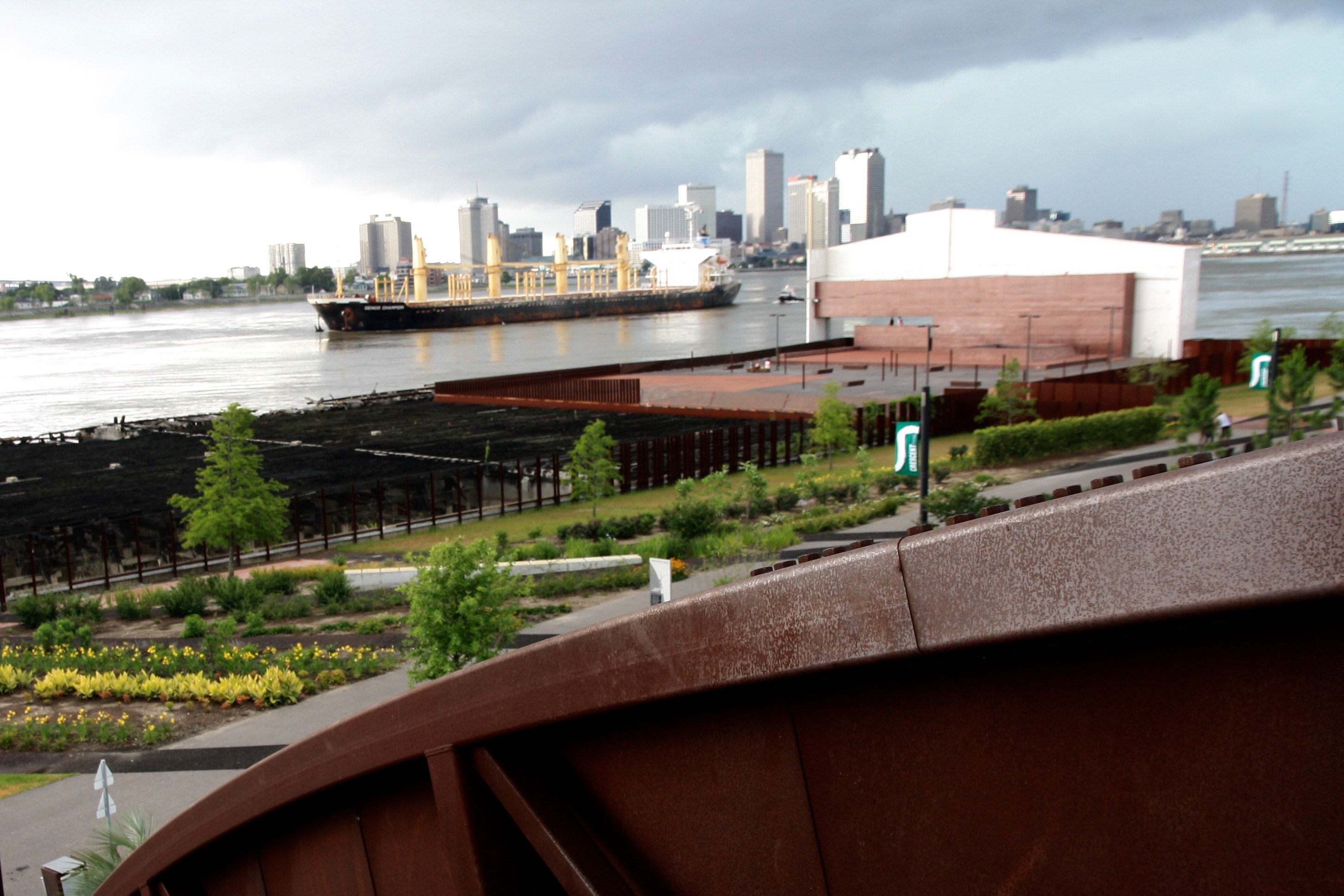
Drivers in New Orleans who make a wrong turn may confront the high concrete walls that line drainage canals and top levees. They, and enormous flood gates and pumping stations, are the product of some $14 billion in flood-protection, funded largely by federal taxpayers, that has been built by the U.S. Army Corps of Engineers in the 10 years since Hurricane Katrina left the city stewing in fetid flood waters for weeks. The Corps is the same agency that under-engineered the levee walls that failed in the storm.
The forbidding walls are the most palpable and ubiquitous elements of this city’s revival. After such an enormous investment, water would seem to be the least of the city’s problems, but that vast infrastructure not only keeps river and gulf flooding out, it keeps the runoff from the city’s ordinary—but torrential—storms in. The forward-thinking and innovative way the the city is handling this problem shows just how much New Orleans has transformed, a story you can find detailed in this month’s Architectural Record.
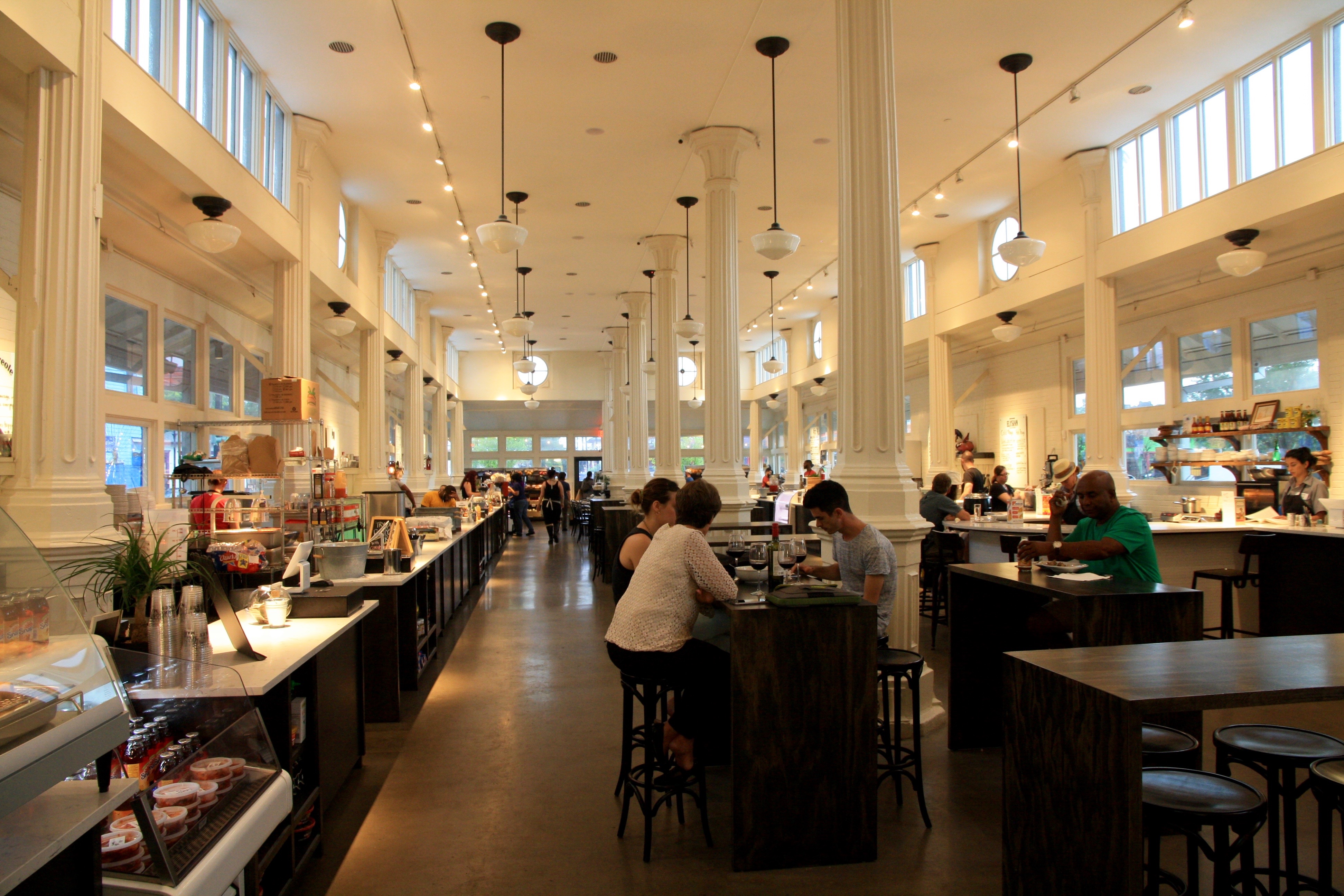
New Orleans has good news to share after a decade (the actual anniversary of the storm’s landfall being August 29), even as the future presents yet more daunting challenges. In interviewing people for my upcoming book, Stories Cities Tell about the Future, New Orleans revealed itself as a study in unexpected contrasts.
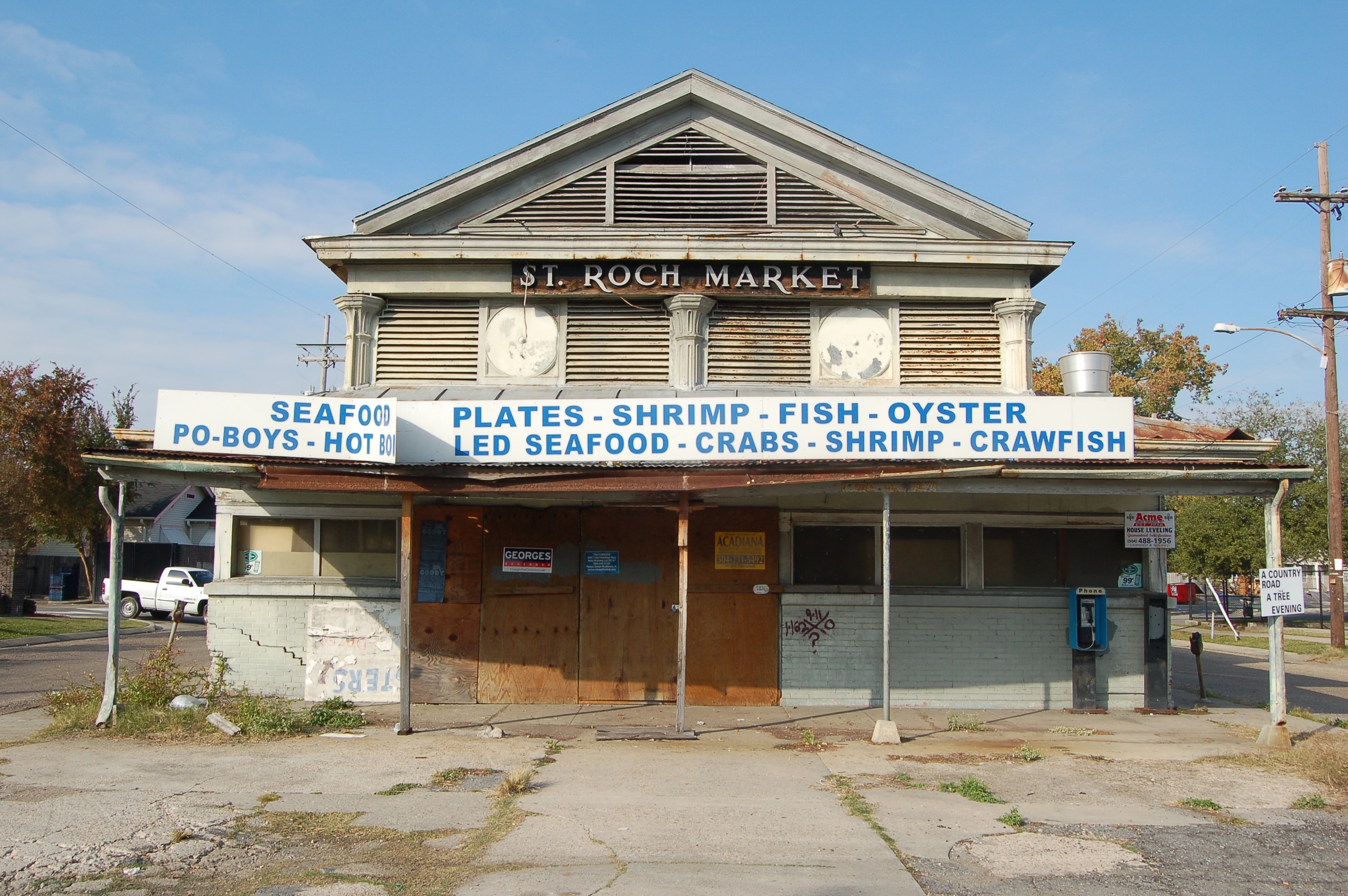
I had to go to Portland, Ore. to learn what a truly different place New Orleans has become. There a young entrepreneur who is part of the city’s much-studied and much-parodied “maker” culture told me that had she not settled in Portland, she would have moved to New Orleans.
Louisiana’s Portland
I wondered what overwhelmingly white, protestant, psychologically introverted Portland could possibly have to do with tropical, easygoing, culturally Catholic Afro-Caribbean New Orleans?
“New Orleans makes young people feel welcome,” Jean Nathan, director of the Creative Alliance of New Orleans (CANO), told me. “It’s what I hear over and over again. Creatives come for Jazz Fest and stay because they find the city to be esthetically oriented and people oriented, with unique architecture. You can ride a bike everywhere.” And it is, or has been, cheap.
“We saw this influx of talent from all over the country,” said Mark Ripple, principal of the admired local architecture firm Eskew+Dumez+Ripple. “A large percentage of our staff came down, loved the place, and stayed to make a difference.”
In covering the city’s recovery over several years I noticed that people and aid groups who swarmed the city to help in the flood recovery didn’t stay weeks, as they intended, but remained for years. So what does Portland have to do with this? Both cities became magnets for people who wanted to be useful, which turns out to include a lot of people with brains, drive, and commitment. For all the destruction, the lives lost or permanently altered, there’s a broad consensus that New Orleans works better and offers greater opportunity than it did before the storm.
The necessary reform of institutions and governance “attracted entrepreneurs, capital, and brains,” said Tim Williamson, who co-founded Idea Village, to nurture entrepreneurs and new leaders in 2000. (Giving a New Orleans spin to startup culture, entrepreneurs have founded their own Mardi Gras krewes.)

I found one young business idealist in a modest collection of renovated retail buildings, located in the Broadmoor neighborhood. Green Coast Enterprises is a new New Orleans developer and property management company that purposely blurs the line between business and social entrepreneurialism. A local bakery has opened next to IDIYA, a “maker” space that does 3D printing and prototypes products. Behind it, Propeller, a light-filled co-work space incubates non-profit social entrepreneurs in a a 10,500 sq. ft. building that had stored tires. Across the intersection Green Coast developed a neighborhood health center with a combination of public, foundation, and non-profit support.
“We built the company somewhat in response to Katrina,” says co-founder and president Will Bradshaw. Few developers take on historically blighted places, he says, “to build places people value.”
Such tiny enterprises have done much to knit New Orleans back together.
“Volunteers who came to help brought more volunteers, but it is the creatives who stuck,” according to Nathan. As well as providing resources and visibility for artists, CANO promotes arts as economically essential to the city, since artisans carry on the long celebratory and historical traditions that make New Orleans uniquely appealing.
Vaughn Fauria incubates building subcontractors and Mardi Gras “Indians”—African-Americans who make elaborate costumes to parade on Mardi Gras and other days. Her NewCorp, founded in 1995, offers technical assistance and financing for “the less glamorous 60 percent of African Americans below the poverty line, 40 percent of whom are underemployed.”
Though she welcomes the entrepreneurial spirit sweeping the city, the focus on digital media or healthcare apps favors “young white folks who have wherewithal,” which she says leaves out too many of the women and African Americans she serves. Still, the jockeying for attention and funding among small entrepreneurs is the kind of problem pre-Katrina New Orleans wished it had.
Stormwater Startups
By contrast, many businesses and elected officials embrace formulaic, high-profile economic development in the form of the 70-acre, $2.7 billion, two-hospital replacement project north of downtown that’s supposed to power a nascent biotech cluster. In this and in digital media, New Orleans is a David to the Goliath of places like Cambridge and Silicon Valley. A more promising local startup culture builds on expertise developed as part of recovery, including construction adapted to flooding and hurricane winds, and water management that relies less on massive, costly “grey” infrastructure and more on natural systems that can be deployed to store and slow floodwaters while creating neighborhood amenity. It’s an economic cluster that the Dutch have built into a major export business.

All of this is possible because local governance has become more responsive and less corrupt. The levee boards have been reformed. Many schools, known for their dysfunction and dilapidation before the storm, have been handsomely restored or replaced with ungainly but functional boxes. Many neighborhoods have been rebuilt, with gentrification spreading to high-ground areas that had seen little investment prior to the storm.
“We are a significantly healthier city,” says Mark Ripple. Yet it is still 100,000 short of its pre-storm population, and less than two-thirds the size of the city at its peak population six decades ago.
Squandered Opportunities
“We’re proclaimed a ‘new’ New Orleans,” says Karen Gadbois, yet “forty percent of children here live in poverty.” She was a textile designer who, like so many others, discovered a new calling after the storm. She founded the widely read blog, Squandered Heritage, that exposed corruption and incompetence in the destruction of intact, architecturally significant houses. Later she co-founded the investigative-reporting website The Lens.
High crime persists, in spite of the bulldozing of preservation-worthy public-housing tracts and their replacement with mixed-income developments, which will ultimately prove just as stigmatizing if they are mismanaged to the degree their predecessors were.
Race still tinges approaches to crime, says Ray Manning, principal of Manning architects. “We’ve still not dealt with problems of the poorest of poor, the least educated.” He asks if the city is doing enough about the factors “that create this person who sees crime as the only way.”
And there are still neighborhoods, famously the Lower Ninth Ward, where rebuilt homes are few and scattered. Ruined malls have been bulldozed in New Orleans East, but replacements have not risen from the acres of empty parking. There are those who say, as they have since the storm, that the costs of maintaining a city only 60 percent of its peak population are unsustainable. But consolidating people in healthy neighborhoods cannot escape the taint of racially motivated displacement.
Still Here
Individuals, recovery groups (many of which sprung up spontaneously), and entrepreneurs can take much of the credit for New Orleans’ rebirth, a case forcefully made by Roberta Brandes Gratz in her new book We’re Still Here Ya Bastards (Nation Books). They were motivated by deep-seated bonds to the city that are extraordinarily impressive to outsiders and don’t exist in the diffuse, interchangeable suburban urbanity that most Americans settle for.
People power can only do so much, however. The economy still relies excessively on tourism. The shiny new school buildings serve up a baffling buffet of city, state, and charter schools, whose performance is much debated.
People fear that a post-storm phenomenon—rapidly rising real-estate prices—threatens the very qualities that make the city attractive—its low costs; its culture of music, art, and food; its embrace of idiosyncrasy
Inescapably a part of the city’s psyche is the specter of The Next Big One, or perhaps more insidiously, the slow, steady, climate-change-induced rise of sea levels—both of which threaten the city. With its ubiquitous concrete fortifications, New Orleans feels more than ever like an island amid melting coastal marshes. The struggle to recover long seemed as if it would inexorably destroy the long traditions that made the city unique. Instead the city’s tenacity in the face of disaster drew from its traditions and culture. In utterly unanticipated ways, it has remained true to itself through it all.


 James S. Russell
Leave a reply to Sead Cancel reply